
InfiniSplat is a feed-forward reconstruction workflow for novel-view rendering from the research group ZJU3DV. V1 turns a single image into an explorable 3D Gaussian Splatting (3DGS) scene, designed to maintain more coherent spatial structure as the viewpoint changes. The updated V2 extends this workflow to multiple photographs of the same scene, reconstructing a 3D Gaussian scene that can be explored from new viewpoints.
InfiniSplat: Exploring a Scene from One Photograph
The original InfiniSplat targets large-baseline novel-view synthesis: moving the virtual camera substantially away from the input viewpoint. An optional depth-guided mode can also use LiDAR measurements as additional input.
InfiniSplat uses estimated geometry to place Gaussian supports along scene surfaces, then predicts their attributes with an implicit decoder. The authors report fewer cracks and more coherent surfaces than the feed-forward baselines they evaluated. However, a single photograph cannot reveal everything behind objects or beyond its frame, so large movements can still expose missing geometry.
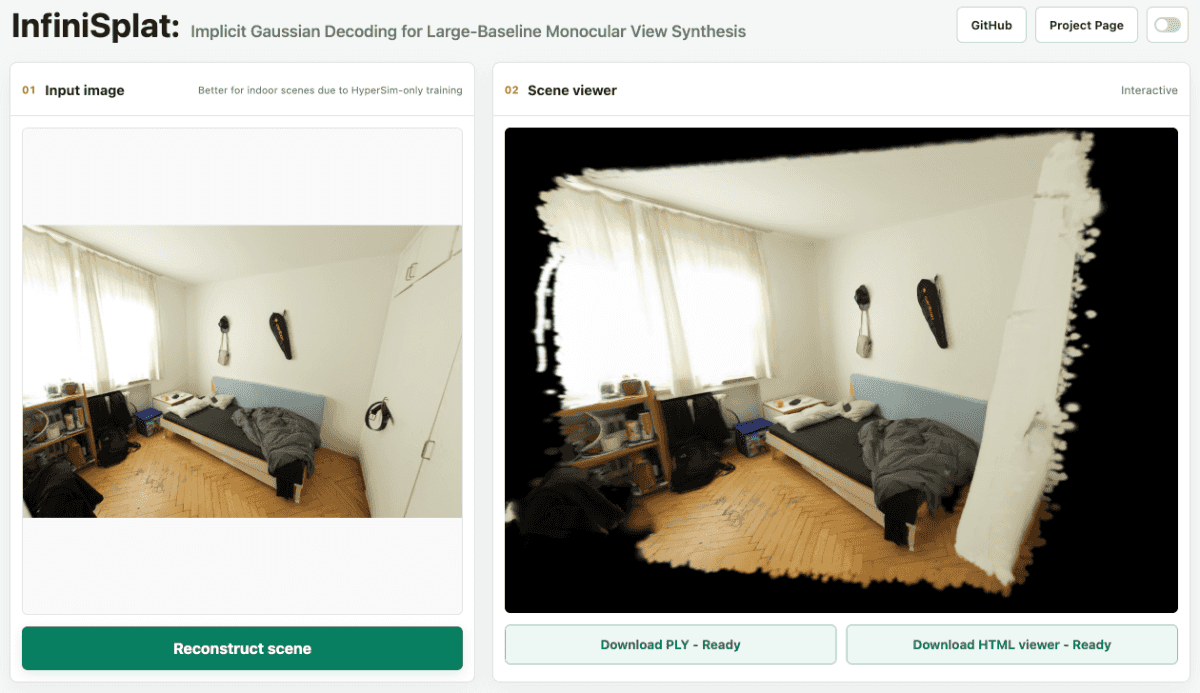 InfiniSplat V1: Single-Image 3D Gaussian Splatting Reconstruction
V2: Multiple Views and Cleaner Gaussian Rendering
InfiniSplat v2 adds overlapping photographs of the same scene, providing observations beyond a single viewpoint. It supports supplied camera poses and intrinsics, or reconstruction without supplied camera parameters.
Built on Depth Anything 3, InfiniSplat v2 addresses a problem with converting predicted geometry into renderable Gaussians: point clouds can contain floating or inconsistent points. The method freezes its geometry branch and trains a separate branch to predict Gaussian attributes. In particular, learned opacity allows unreliable points to contribute less to the final rendering. Rather than requiring every imperfect point to be corrected geometrically, the model can reduce the visual impact of inconsistent geometry when producing new views.
 InfiniSplat V2: Multi-View 3D Gaussian Splatting Reconstruction
Training also uses scale-aligned ground-truth cameras and target views with larger angular differences. The authors report improved rendering under large viewpoint changes. Reconstruction still depends on what the input photographs cover.
Trying the Release
InfiniSplat v2's installation guide provides inference setup and download instructions for pretrained weights and example data. The V2 preprint is now available, and the project provides a link to a Hugging Face demo.
Local inference requires an NVIDIA CUDA GPU. Results can be exported as Gaussian PLY files, with an optional standalone HTML viewer.
Learn more: InfiniSplat V1 and V2 repository